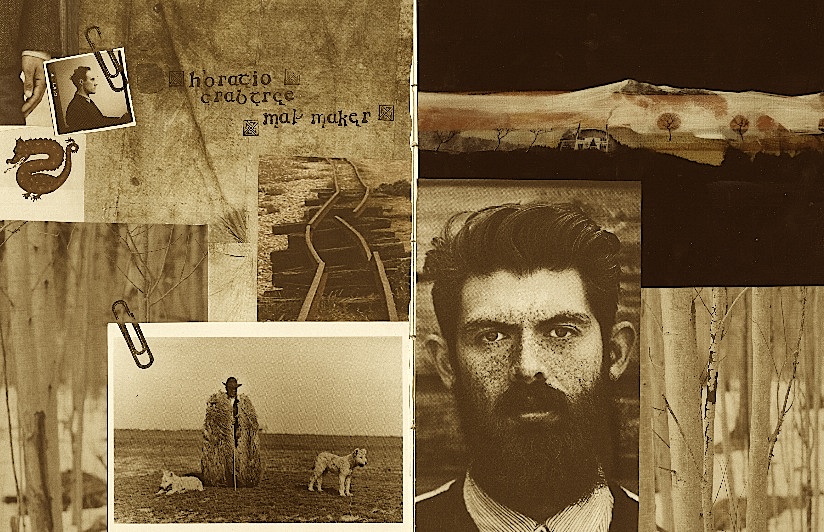
Writing with Images
Throughout spring/summer 2026, I have been running a series of creative writing workshops under the umbrella title Writing with Images exploring the application of visual arts techniques to the writing of fiction and non-fiction. The idea for the workshops stems from my lifelong interest in the work of artists who write (and writers who are artists) – Vincent Van Gogh, Derek Jarman, Celia Paul, Brenda Chamberlain and Mervyn Peake to name a few of my favourites. I’m intrigued by the way they move between image and text, why they do this and how it must help shape the writing process. My own writing is very much inspired by my love of visual art, and the processes of making art.
What if we rummage through the photographer’s toolkit or the artist’s workbench to find not just inspiration to write but techniques/processes which might impact the way we write? I brought in Ania Ready and Carole Webster two writers/visual artists to co-facilitate the programme of workshops held at the University of Essex. Each workshop was a stand-alone, but all were linked through texts held in the archive of Sophie Gaudier-Brezska in the Special Collections at the University. Sophie’s migratory life moving between countries and languages acted as inspiration and guiding thread throughout, along with black and white photographs ‘re-enacting’ aspects of Sophie’s life created by Ania Ready.
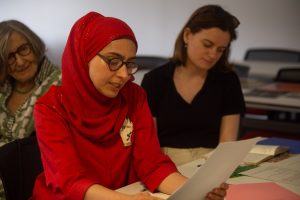
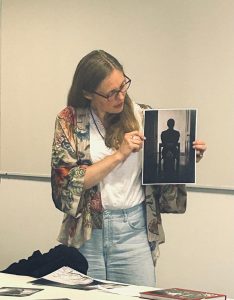
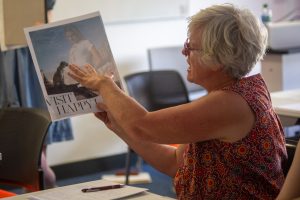
Ania and I are now developing the workshop template further so we can collaborate with other research institutions and specialist archives in the near future. The aim is to activate the archive through creative engagement, bringing together scholars and local communities, and writers of all levels with other creative practitioners. Over the past three months, an amazing mix of people have been engaging with Writing with Images, aged 16+ to over 70; some were returning to writing, others were visual artists attracted to the theme including printmakers, photographers, a filmmaker and a website designer. It was a joy sharing the journey with them all, and my co-facilitators. I can’t wait to take these workshops to the next level. More on this soon, hopefully! Below, some images from the third workshop taken by Ania (and the photo of Ania presenting one of her images by someone who came along to the session!)
A Map for the Lost
Working on a new draft of A Map for the Lost. It’s my new novel and it’s themes are female friendship, grief and the relationship between art making and recovery. Set in 1980s Sussex, the narrators are Erin McGonigle, a restaurant worker in her late forties, and Annie MacRae, a twenty-year-old fine art student. The story begins when Annie meets Declan, Erin’s estranged son. Their relationship becomes the catalyst to uncover long-held secrets of the past: the fate of a missing brother, and the identity of an unknown father. Below, some vision board inspirations. The pen and ink drawing of a row of houses in Lewes is from one of my old sketchbooks, the photo of the boats was taken on Brighton beach, and the magazine cover is from a Viva Lewes special on Bonfire Night. Some clues there maybe about what might be found in the novel!

The House of Swallows
The House of Swallows is a work of literary fiction which reflects on legacies which are not always visible – an unknown bloodline, a hidden artistic legacy, a missing child – explored through the stories of three artist-makers, each connected to the exhumation of a Spanish Civil War grave in the early 2000s.
It is inspired by historical events which I heard about whilst on a writing residency in Andalucía funded by the Arts Council. It was the story of those ‘disappeared’ during the Spanish Civil War and in the years of dictatorship which followed. I was particularly drawn to the stories of the grandchildren growing up in the diaspora who are finding new and creative ways to research and document the lives of the ‘disappeared.’
Nell Costello’s story frames my novel which spans the 1930s to the first decade of this century. My literary experiment takes the form of fracturing my characters’ narratives across time and threading them together through poetic fragments, official documents, and recurring visual motifs drawn from historical and fictional artworks, including Picasso’s Guernica.
The novel forms part of my postgraduate research project funded by AHRC (Arts and Humanities Research Council) & CHASE (Consortium for the Humanities and the Arts South-East England). I was awarded my PhD by the University of Essex in 2019.
“Las palabras viven y crecen también en la sombra. Hay formas de resistencia y de transmisión. La memoria tiene su propia estrategia.” (Words also live and grow in the darkness. They are forms of resistance and transmission. Memory is its own strategy). Manual Rivas.
“No se recuerda, no se juzga el pasado solo para castigar o condenar, sino para aprender.” (One remembers not to judge the past, to punish or condemn, but to learn.) Luis Pérez de Aguirre.

In Wolf Village
My first novella is about a photographer confronting the ugly compromises involved in reporting from a conflict zone. The novella has been inspired by the writings of the Surrealist artist Max Ernst, particularly his reflections on forests and his lifelong habit of confounding images of human beings with birds and other creatures. Somewhere along the way, this collided with my interest in maps and the work of women photographers such as the Hungarian artist Kati Horna, who documented the Spanish Civil War and was a lifelong friend of the visual artist Leonora Carrington.
In Wolf Village was shortlisted for The Novella Award (Judges: Nicholas Royal & Alison Moore)
The project was developed with the support of a Hawthornden Fellowship and a residency at the Tyrone Guthrie Centre, Ireland.